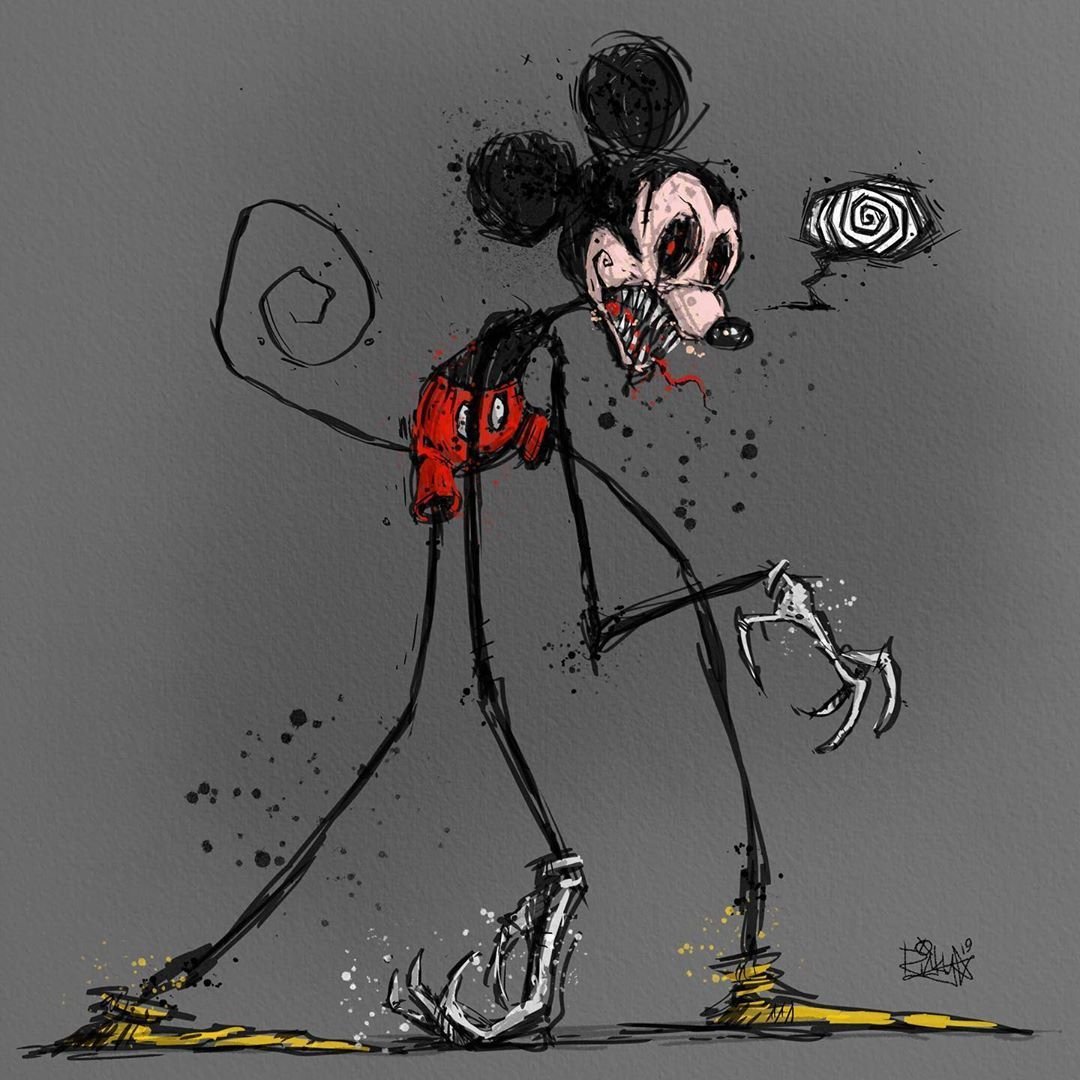
From the moment he first whistled on a steamboat, Mickey Mouse became an emblem of joy, optimism, and childhood innocence. For nearly a century, his smiling face has adorned everything from lunchboxes to theme park castles, symbolizing the magic of Disney. Yet, beneath this squeaky-clean facade, a curious and compelling phenomenon has taken root: The Evolution of Scary Mickey Mouse Lore. It's a journey that transforms a beloved, cheerful character into a figure of unsettling horror, revealing as much about our collective anxieties as it does about the enduring power of iconic imagery.
This isn't about Mickey himself being scary, but rather how our perception, fueled by fan creativity and the sheer weight of his cultural impact, has twisted his image into something truly eerie. It’s a fascinating case study in how an icon can be subverted, reclaimed, and reimagined in the darkest corners of human imagination.
At a Glance: Mickey's Dark Transformation
- From Innocent to Eerie: Mickey Mouse, initially a mischievous cartoon character, evolved into a symbol of pure optimism, making his subversion into horror particularly potent.
- Early Unsettling Traits: Mickey's "rubber hose" animation and "pie eyes" in the 1930s, though innocent at the time, contained elements that could be reinterpreted as unsettling.
- The Power of Subversion: The vast difference between Mickey's official persona and his scary lore amplifies the shock and appeal for creators and audiences.
- Creepypasta's Rise: Stories like "Suicide Mouse" cemented Mickey's place in internet horror, exploiting themes of lost episodes and corporate secrets.
- Public Domain's Impact: The 2024 entry of "Steamboat Willie" into the public domain unleashed a wave of official horror adaptations, blurring the lines between fan lore and commercial fright.
- Psychological Resonance: Scary Mickey lore taps into our primal fears about corrupted innocence, hidden darkness, and the breakdown of reality.
The Mouse's Genesis: From Scrappy Upstart to Global Ambassador
To understand how Mickey became scary, we first need to appreciate his original, wholesome journey. Born out of necessity after Walt Disney lost the rights to Oswald the Lucky Rabbit, Mickey Mouse debuted as a scrappy, mischievous rodent. He was designed by Walt Disney, Ub Iwerks, and Les Clark, and initially embodied a spirit of youthful exuberance and playful defiance.
His very first produced cartoon, "Plane Crazy" (1928), showcased a Mickey who was bold, overconfident, and even a bit reckless. He didn't have his signature white gloves or oversized shoes, and his fingers sometimes varied in number. This early iteration was a far cry from the polished ambassador we know today; he was more of an underdog, always getting into scrapes.
The Defining Moments of Mickey's Early Look
It was "Steamboat Willie" (1928), the first publicly released cartoon featuring synchronized sound, that truly introduced Mickey to the world. Here, he was flirtatious and curious, demonstrating actions typical of a teenager. His eyes, initially small black ovals, were redesigned for greater expressiveness, a subtle change that gave him more emotional range. Soon after, his trademark oversized shoes debuted in "The Gallopin’ Gaucho" (1928), adding to his distinct silhouette.
The iconic white gloves, often attributed to making his hands stand out against his black body, first appeared as a stage costume element in "The Opry House" (1929), quickly becoming a permanent fixture by "When the Cat’s Away" (1929). Eventually, his finger count settled at three fingers and a thumb, an animation shortcut that became synonymous with cartoon characters. Mickey even gained his voice in "The Karnival Kid" (1929), making him even more relatable and giving him a personality beyond pantomime.
The "Inkblot" and "Rubber Hose" Era: Unintentional Unease
From 1929, the "pie-eyed" Mickey, with large, pupil-less eyes, predominantly appeared in print cartoons. Meanwhile, animated shorts continued to use the black oval eyes for dynamic expression. This design was characteristic of the "Inkblot Cartoon Style" and "rubber hose" animation prevalent in the 1930s.
This early animation style, marked by nonsensical slapstick, highly flexible limbs that bent like rubber hoses, and a general disregard for physical realism, could be unintentionally unsettling to modern eyes. While endearing and revolutionary for its time, the fluid, sometimes grotesque movements and exaggerated expressions of early cartoons, including Mickey’s, laid a subtle groundwork for later reinterpretations. This style was an industry standard until 1939, with "Society Dog Show" featuring its last remnants as Disney pushed towards more realistic character depictions.
Transition to Color and Heroism: The Softening of Mickey
The first color cartoon featuring Mickey, "Parade of the Award Nominees" (1932), was a special, non-public release for the 5th Academy Award® ceremony. It wasn't until "The Band Concert" (1935) that Mickey officially appeared in a standard, publicly released color cartoon, definitively establishing red as the color of his signature shorts.
Around this pivotal time, a significant shift in Mickey's personality occurred. His mischievous prankster traits were gradually passed to Donald Duck, allowing Mickey to evolve into an endearing romantic lead and a humble hero. This transformation is beautifully showcased in shorts like "On Ice" (1935), where his kind and helpful nature began to shine.
His facial features softened, making him appear younger, yet his personality matured into one of gentle leadership. Animator Fred Moore's design brought a rounder fullness to his cheeks and even greater flexibility to his movements. "Brave Little Tailor" (1938) is often considered a peak in Mickey's career, earning an Academy Award® nomination and presenting a curious, wholesome, and courageous version of the character. "The Sorcerer’s Apprentice" from "Fantasia" (1940) was specifically planned to restore Mickey's popularity, portraying him as eager to learn but still desiring fun. This era saw a significant redesign towards a more realistic interpretation, with his eyes now featuring distinct pupils, a departure from the earlier black ovals.
Today, Mickey Mouse is instantly recognizable by his iconic red shorts, yellow shoes, and white gloves. His personality is a beacon of optimism, bravery, kindness, and calm. He is, without question, the global ambassador of The Walt Disney Company, perfectly embodying Walt Disney's enduring sentiment: "it was all started by a mouse."
The Unintended Shadows: How Innocence Became Eerie
Given his meticulously crafted image of wholesome joy, how did Mickey Mouse become a canvas for horror? The evolution of scary Mickey lore isn't just about fans making up spooky stories; it's rooted in several psychological and cultural factors that make his transformation so uniquely unsettling.
The Power of Simplicity and Abstraction
Mickey's design is deceptively simple: three circles for his head, large ovular eyes, and minimal facial features. This abstraction, while making him universally recognizable, also makes him incredibly versatile for distortion. When an artist takes those familiar, simple lines and subtly twists them – elongating a smile, darkening an eye, or exaggerating a gesture – the effect can be profoundly disturbing. It’s the familiar made alien, and that's a potent ingredient for fear.
The "Uncanny Valley" Effect
The uncanny valley is a concept in robotics and aesthetics that describes the unsettling feeling we get when something looks almost human, but not quite. While Mickey is far from human, his early "rubber hose" animation, with its nonsensical physics and often exaggerated, almost violent slapstick, can, in retrospect, trigger a similar feeling. His highly flexible, almost boneless limbs and sometimes disproportionate features, especially in his oldest cartoons, can feel strangely off when viewed through a modern lens, subtly preparing the ground for more intentional horror.
Corporate Monolith vs. Independent Creator
The Walt Disney Company is one of the largest and most protective media conglomerates in the world. Mickey Mouse isn't just a character; he's a brand, a symbol, and a tightly controlled intellectual property. This corporate ubiquity and strict control over his image paradoxically fuel the desire for subversion. Independent creators, driven by a rebellious spirit or simply the urge to explore darker themes, find great satisfaction in taking something so thoroughly "owned" and transforming it. It's an act of cultural reclamation, turning the symbol of the establishment into a vehicle for counter-narratives.
Nostalgia and its Dark Side
For many, Mickey Mouse is synonymous with childhood, innocence, and happy memories. When something so deeply ingrained in our collective positive nostalgia is corrupted, the impact is far greater than if a lesser-known character were subjected to the same treatment. The horror isn't just in the monstrous depiction; it's in the violation of something pure, the shattering of a beloved memory. This subversion of innocence is a classic horror trope, and Mickey is perhaps its most high-profile victim.
The Birth of Modern Scary Mickey Lore (Creepypastas & Beyond)
While the seeds of unease might have been present in Mickey's early abstract form, the explosion of modern scary Mickey lore largely owes itself to the internet, specifically the rise of "creepypasta" – internet horror stories shared and spread online.
The Legend of "Suicide Mouse" (Lost Episode)
Perhaps the most famous and foundational piece of scary Mickey lore is "Suicide Mouse," also known as "Mickey Mouse Lost Episode" or "mickey.avi." This creepypasta, which emerged in the mid-2000s, purports to describe a "lost" 1929 Mickey Mouse cartoon that begins innocently but quickly descends into disturbing imagery, unsettling audio loops, and psychological horror.
The story typically claims that the short was so terrifying it was suppressed by Disney, with only a few employees ever witnessing its full, sanity-shattering duration. Descriptions often include Mickey walking with a perpetually grim expression, distorted buildings, a repetitive, off-key piano loop, and eventually, the cries of a woman, distorted screams, and a final, horrifying message or image that drives viewers to madness or suicide. The genius of "Suicide Mouse" lies in its ability to tap into the "lost episode" trope, suggesting a hidden, dark secret within the pristine Disney archive. It exploits the idea that something so universally happy could harbor an unspeakable terror.
The Creepypasta Phenomenon and "Lost Episode" Trope
"Suicide Mouse" wasn't an isolated incident; it was a perfect storm of internet culture. Creepypastas thrive on urban legends, found footage narratives, and the idea of hidden truths. The "lost episode" trope is particularly effective because it preys on our curiosity and our belief that corporate entities might conceal disturbing content.
For Mickey Mouse, this trope gained immense traction. Who wouldn't be intrigued by the idea of Walt Disney, the master of dreams, creating something so profoundly disturbing that it had to be buried? This narrative creates a powerful, almost irresistible pull for horror enthusiasts. The story's effectiveness doesn't rely on graphic gore but on psychological dread, the corruption of innocence, and the suggestion of something fundamentally wrong with a beloved character.
As you Explore scary Mickey Mouse lore further, you'll find that "Suicide Mouse" served as a blueprint, inspiring countless other stories that leverage the same unsettling techniques.
Visual Distortions and Psychological Horror
Modern scary Mickey lore often goes beyond narrative, utilizing visual and auditory distortions. Artists and animators create unsettling versions of Mickey that play on the uncanny valley, featuring:
- Exaggerated Smiles: Turning Mickey's cheerful grin into a wide, menacing rictus.
- Empty or Glitching Eyes: Replacing his familiar eyes with hollow voids or digitally corrupted pixels.
- Distorted Proportions: Elongating limbs, shrinking his head, or making him appear gaunt and emaciated.
- Unsettling Audio: Looping discordant music, distorted laughs, or sudden, jarring screams.
These elements combine to create a deeply unsettling experience that leverages Mickey's established visual language against itself. The horror isn't just external; it's internal, playing on our expectations and twisting them into something nightmarish.
Key Archetypes and Recurring Themes in Scary Mickey Lore
Across the myriad of scary Mickey stories, certain themes and archetypes consistently emerge, revealing the psychological undercurrents of this dark fascination.
The Abandoned/Broken Mascot
A frequent motif is Mickey as a victim – abandoned in an old cartoon studio, forgotten in a digital archive, or suffering a mental breakdown. This version often portrays Mickey as a tragic figure who, after years of forced cheerfulness, snaps or becomes vengeful. He might be depicted as a sad, decaying puppet, or a tormented spirit haunting his former joyful haunts. This plays on our empathy for the character, then twists it into fear when his suffering turns outward.
The Evil Animator/Creator
Some lore posits that the creator is the source of the horror. Stories might suggest Walt Disney himself was obsessed, creating disturbing content, or that a rogue animator introduced malevolent elements into the cartoons. This theme often reflects a distrust of authority and corporate control, blaming the system for Mickey's dark transformation. It's a meta-commentary on the power dynamics behind beloved media.
Reality Glitches and Corruption
Another popular theme involves Mickey breaking the fourth wall or glitching out of his cartoon reality. He might appear in our world as a distorted, decaying entity, or his cartoon world might become corrupted, transforming into a nightmarish landscape. This taps into the fear of reality breaking down, of the safe, predictable world revealing a dark, digital underbelly. It suggests that even the most meticulously constructed fictional universes can be breached and twisted.
Body Horror and Gore
While less common in the early, psychological creepypastas, later iterations of scary Mickey lore, especially with increased visual capabilities, introduce elements of body horror. This might include Mickey's limbs being torn off, his face melting, or internal organs being exposed. This more visceral form of horror aims for shock and disgust, directly contrasting with Mickey's clean, simple design.
Existential Dread and The "Experiment Gone Wrong"
Deeper lore explores existential themes, portraying Mickey as a character trapped in an endless loop, aware of his own fictional nature, or driven mad by the repetition of his existence. He might be a failed experiment, an AI gone rogue, or a consciousness suffering within the confines of his cartoon world. This kind of horror is intellectual, forcing the audience to grapple with questions of free will, identity, and the nature of reality itself, all through the lens of a familiar character.
Mickey's Public Domain Future and the Explosion of Horror (Post-2024)
The landscape of scary Mickey lore underwent a seismic shift on January 1, 2024. On this date, the copyright for "Steamboat Willie" (1928), featuring the earliest iteration of Mickey Mouse, officially expired, placing this specific version of the character into the public domain.
The Significance of Public Domain
For nearly a century, Disney rigorously protected Mickey Mouse, famously lobbying for extensions to copyright law. The public domain entry of "Steamboat Willie" means that anyone can now freely use, adapt, and transform this early, black-and-white version of Mickey without fear of legal repercussions from Disney. This is a monumental shift, as it liberates a cultural icon from corporate ownership, at least in its nascent form.
Crucially, it's only the "Steamboat Willie" version of Mickey (and Minnie) that entered the public domain. Later, more recognizable versions with signature red shorts, white gloves, and distinct personality traits remain copyrighted. However, the floodgates for horror adaptations were thrown wide open.
From Fan Lore to Commercial Horror
Prior to 2024, scary Mickey lore largely existed in the realm of fan-made creepypastas, indie games, and amateur art. These creations always walked a fine line, often using disclaimers or highly altered designs to avoid legal issues. With the "Steamboat Willie" iteration in the public domain, creators no longer need to fear legal action when depicting a monstrous, homicidal, or otherwise terrifying version of this specific Mickey.
This change has led to an explosion of commercially produced horror content:
- Horror Films: Just weeks into 2024, trailers for horror films like "Mickey's Mouse Trap" and "The Vanishing of S.S. Willie" emerged, depicting Mickey as a slasher villain or a creature of terror. These films embrace the blood and gore often found in other public domain horror adaptations (like Winnie the Pooh).
- Video Games: Indie game developers quickly jumped on the opportunity, releasing titles like "Infestation: The New Blood" and others that transform Mickey into a monster in survival horror or psychological thrillers.
- New Narratives: The public domain status allows for a richness of storytelling that goes beyond the "lost episode" trope, enabling creators to craft entirely new, dark origins and futures for the character.
This shift blurs the line between fan-created lore and legitimate, commercial horror. It legitimizes the scary Mickey phenomenon in a way that was previously impossible, allowing artists to explore the character's terrifying potential without constraint. It also fundamentally changes Mickey's legacy, adding a new, permanent layer of darkness to his multifaceted identity.
Why We Love to Fear the Mouse: The Psychology of Subversion
So, what is it about scary Mickey Mouse lore that resonates so deeply? Why do we, as an audience, embrace the corruption of such an innocent figure?
The Thrill of Transgression
There's an inherent thrill in seeing taboos broken. Mickey Mouse is arguably the most sacred cow of American pop culture. To twist him into a grotesque monster is an act of defiance, a transgression against the established order. It’s a way to engage with forbidden ideas and explore the darker aspects of creativity without real-world consequences. This safe transgression offers a cathartic release.
Reclaiming Agency from Corporate Giants
In an increasingly commodified world, media giants like Disney wield immense cultural power. Subverting their most iconic character is a way for individuals and communities to reclaim a small piece of that power. It's a statement that culture isn't solely dictated from the top down; it's also shaped by the collective imagination of the people. By making Mickey scary, fans assert their own creative agency over a character that has long been strictly controlled.
Exploring the Darker Side of Humanity Through Familiar Symbols
Art, including horror, often serves as a mirror to humanity's darker impulses. By using a universally recognized and beloved symbol like Mickey Mouse, creators can explore themes of madness, violence, abandonment, and existential dread in a way that is immediately impactful. The contrast between Mickey's intended persona and his horrific transformation amplifies the message, making the exploration of these dark themes even more poignant and disturbing. It helps us confront our own fears by seeing them reflected in something familiar.
The Enduring Power of Archetypes
Mickey Mouse, despite his simplicity, has achieved an archetypal status. He represents innocence, optimism, and the pioneering spirit. When an archetype is subverted, it shakes us to our core because it challenges fundamental ideas we hold about good and evil, purity and corruption. This profound psychological impact ensures that scary Mickey lore will continue to fascinate and terrify for generations to come.
Beyond the Bowtie: Mickey's Enduring Evolution
The evolution of scary Mickey Mouse lore is far more than just a collection of creepy stories; it's a profound cultural dialogue. It began with the subtle, unintended unease of early animation, gained momentum through the democratic platform of the internet and creepypasta, and has now burst into the mainstream with the public domain entry of his earliest form.
Mickey Mouse, the character Walt Disney famously said "it was all started by a mouse," continues to evolve in ways his creators could never have imagined. He remains the optimistic ambassador of Disney, but he has also, irrevocably, become a canvas for our deepest fears and our most rebellious creative urges. This dual identity – both a beacon of joy and a harbinger of dread – ensures that Mickey Mouse will remain an endlessly fascinating figure. Whether you prefer him whistling on a steamboat or lurking in the shadows, his story is far from over.